The BeAutomated journal
Pay $3–$5 CPC: ChatGPT Ad Costs 2026 for Australian Tests
Expect $3–$5 CPC and $25–$45 CPM. Run $100–$300/day tests for 2–4 weeks, then switch to CPA. Practical tracking and setup steps for Australian advertisers.
Pay $3–$5 CPC: ChatGPT Ad Costs 2026 for Australian Tests
Start with click bidding at $3–$5 per click, budget a moderate daily amount for a few weeks to test campaign effectiveness, and expect CPMs in the $25–$45 band. That’s the current shape of ChatGPT ads cost in the real world, not the pilot-era headline prices from last year. Once your tracking is verified, shift toward cost-per-action bidding, because that’s where the channel actually earns its keep.
TL;DR:
- Current CPMs for ChatGPT ads have decreased to $25–$45, with some partners reporting as low as $15, making it more competitive against Google and Meta.
- Cost-per-click typically starts at $3–$5, with higher prices for finance, legal, or insurance categories and lower costs for local services.
- Transitioning to cost-per-action bidding improves campaign measurement once verified conversion tracking is established, lowering overall costs.
- Success depends on matching landing page signals and creative relevance to context hints, as relevance affects auction outcomes.
- A typical test budget ranges from $2,000 to $15,000 over two to three months, focusing on achieving a predefined CPA fail threshold before scaling.
BeautomatedTurn More Enquiries Into ConversationsBeAutomated helps Australian businesses automate follow-ups, streamline communication, and recover missed client interactions with AI-driven automation.See how BeAutomated helps
Table of Contents
- What does ChatGPT ads cost look like right now?
- How does ChatGPT ad pricing and delivery actually work?
- Where do you actually buy ChatGPT ads?
- What test budget should you actually run?
- Is ChatGPT ad ROI actually comparable to Google or Meta?
- What technical setup do you need before you can bid on performance?
- When should ChatGPT ads sit in your media mix?
- How BeAutomated sets up and manages your ChatGPT ad pilot
- Sources
- FAQ
What does ChatGPT ads cost look like right now?
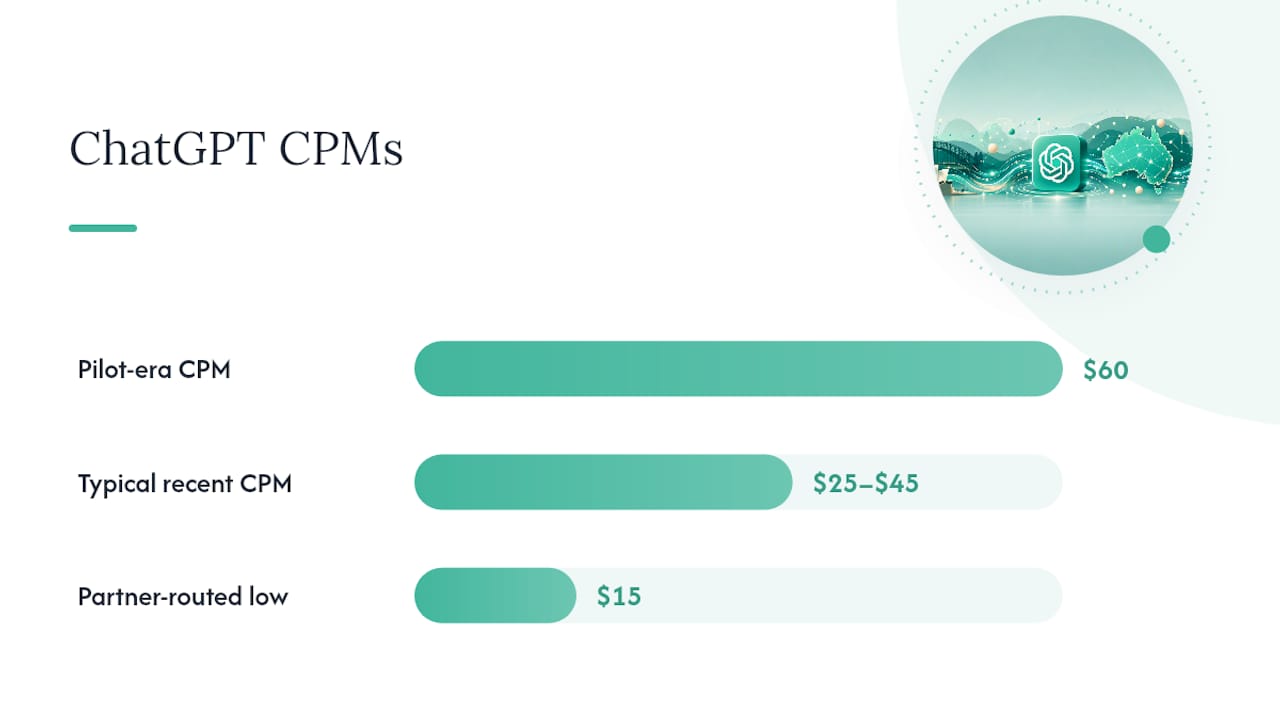
The numbers have moved a long way since OpenAI’s early pilot, when CPMs sat around $60. Digiday reported that ChatGPT ad prices have softened considerably, with CPMs now typically landing between $25 and $45, and some partner-routed buys reported as low as $15. That’s a meaningful drop, and it changes the calculation for anyone comparing ChatGPT advertising prices against Google or Meta.
CPC is now the more useful entry point for most advertisers, because it ties spend directly to traffic rather than raw impressions. The practical starting range sits at $3 to $5 per click, though this varies by vertical.
- Competitive B2B categories (finance, legal, insurance) often clear closer to the top of that band or above it.
- Lower-competition local service categories can land nearer $3.
- Retail and e-commerce queries sit somewhere in the middle, depending on seasonality.
Pro Tip: Don’t anchor your budget to the $60 CPM you might have read about in early coverage. That figure is a pilot-era artefact — current benchmarks are well below it, and using the old number will make your test budget unnecessarily conservative.
The bigger structural shift is that OpenAI has rolled out cost-per-action bidding for accounts with verified conversion tracking. That’s the change that turns ChatGPT from an awareness experiment into a measurable performance channel, and it’s the reason the “affordable ChatGPT ads” conversation has shifted from CPM to CPA over the past year. There’s no platform minimum spend blocking entry either. Self-serve access through Ads Manager is open, which means the barrier to testing is lower than it was even six months ago.
How does ChatGPT ad pricing and delivery actually work?
ChatGPT runs a relevance-weighted second-price auction. You don’t simply pay your bid; you pay just enough to beat the next-highest competitive bid, adjusted for how relevant the platform judges your ad to be in that conversation. A highly relevant ad with a modest bid can beat a higher bid attached to a weaker match.
Relevance here isn’t keyword matching. It’s built from context hints you supply, the topical alignment of your landing page, and the quality of your ad creative. OpenAI’s own guidance is explicit that context hints are not exact-match keywords — they steer matching, but the landing page has to back up the claim or the system will discount your relevance score regardless of hint quality.
- Context hints tell the auction what your ad is about, broadly.
- Landing-page topical signals confirm (or contradict) those hints.
- Creative quality feeds into the same relevance calculation.
Pro Tip: Before you touch your bid, audit your landing page copy against your ad’s context hints. A mismatch there is the single most common reason advertisers overpay for underperforming impressions.
This is a genuinely different discipline from keyword-based search buying. You’re not bidding against a fixed match type; you’re being scored on coherence between what you say, where you send people, and what the conversation is actually about.
Where do you actually buy ChatGPT ads?
Two routes exist, and the choice matters more than most first-time advertisers expect. The direct route is OpenAI Ads Manager, the official self-serve platform where you set objectives, budgets, and bids, and where you connect pixels or Conversions API integrations. There’s no platform-imposed minimum spend to get started.
The other route runs through adtech partners. Advertisers commonly access ChatGPT inventory via Criteo, StackAdapt or Skai, each of which layers its own tools and, in some cases, its own minimums on top of the underlying auction.
- Direct Ads Manager suits advertisers who already run first-party tracking and want granular control over bidding.
- Partners suit advertisers who need existing product feed integrations, or who are already running Criteo, StackAdapt or Skai campaigns elsewhere and want unified reporting.
- Partner-routed buys can show different observed costs than direct buys, partly because of how each partner packages inventory and reports blended metrics.
Neither route is objectively cheaper. The right one depends on what integrations you already have running and how much manual control you want over bid strategy.
What test budget should you actually run?
Structure your test in phases rather than committing a lump sum on day one. Practitioner guidance consistently points to the same starting numbers: Clicks objective at $3–$5 CPC, daily budgets of $100 to $300, and a test window of two to four weeks before making any scale decision.
- Weeks 1–2: Run Clicks at your chosen CPC with a $100–$300 daily budget. Watch click-through rate and cost-per-click against your own historical search or social benchmarks.
- Weeks 2–4: If CTR holds and CPC stays within range, extend the test and start layering in conversion tracking if it isn’t live yet.
- Once you have roughly two to four weeks of verified conversion data, switch bidding to CPA and let the platform optimise against real outcomes rather than clicks alone.
- Set a fail threshold up front: if blended CPA sits meaningfully above your Google or Meta benchmark after the full test window, pause and diagnose landing-page or creative fit before spending more.
For budget sizing, a small advertiser might run $2,000–$4,000 across the full test window; a mid-size team might commit $5,000–$15,000 over 60 to 90 days, which aligns with the pilot ranges several practitioner guides recommend; an enterprise advertiser testing multiple creative sets and audiences across verticals could run several parallel $10,000+ tests simultaneously. The number that matters most isn’t the total spend, it’s whether you hit your CPA fail threshold before the budget runs out.
Is ChatGPT ad ROI actually comparable to Google or Meta?
Early reporting suggests ChatGPT performs strongest in decision-oriented, research-heavy queries, the moments where someone is actively comparing options rather than passively scrolling. That’s a different behavioural context than a Meta feed impression, and it’s part of why direct CTR comparisons across channels can mislead.
- Model your blended CPA over a full attribution window, not a same-day snapshot, because conversational research often precedes a purchase decision by days.
- Run a 90-day parity check against your existing search and social benchmarks before reallocating meaningful budget.
- Expect stronger fit in categories where buyers actively ask comparative questions, mortgages, insurance, home services, and weaker fit for enterprise or premium buyers who may be on ad-free ChatGPT tiers.
- Use a longer attribution window than you would for a paid social campaign, since the query behaviour tends to sit earlier in the funnel.
The audience skew matters too. Paid ChatGPT tiers that strip ads mean some higher-value decision-makers simply never see your placement, which is worth factoring into any category where your buyer is likely to be a paying subscriber.
What technical setup do you need before you can bid on performance?
You can’t access CPC or CPA bidding meaningfully without conversion tracking in place first. Skip this step and you’re stuck buying on CPM, which is the least cost-effective option for anyone chasing leads rather than reach.
- Install and verify the pixel or Conversions API integration before you launch, not after your first flight.
- Confirm your landing page’s meta-data and topical signals align with the context hints you’re feeding the auction, since OpenAI’s crawler weighs this in relevance scoring.
- Run a manual end-to-end conversion test, click through, convert, confirm the event fires, before you commit real budget.
- Check your tracking setup against OpenAI’s Ads Manager documentation rather than assuming a generic pixel install will work identically to Meta or Google.
Pro Tip: A pixel that fires on page load but not on the actual conversion event is the single most common setup error advertisers report. Test the exact conversion action, not just whether the pixel loads.
When should ChatGPT ads sit in your media mix?
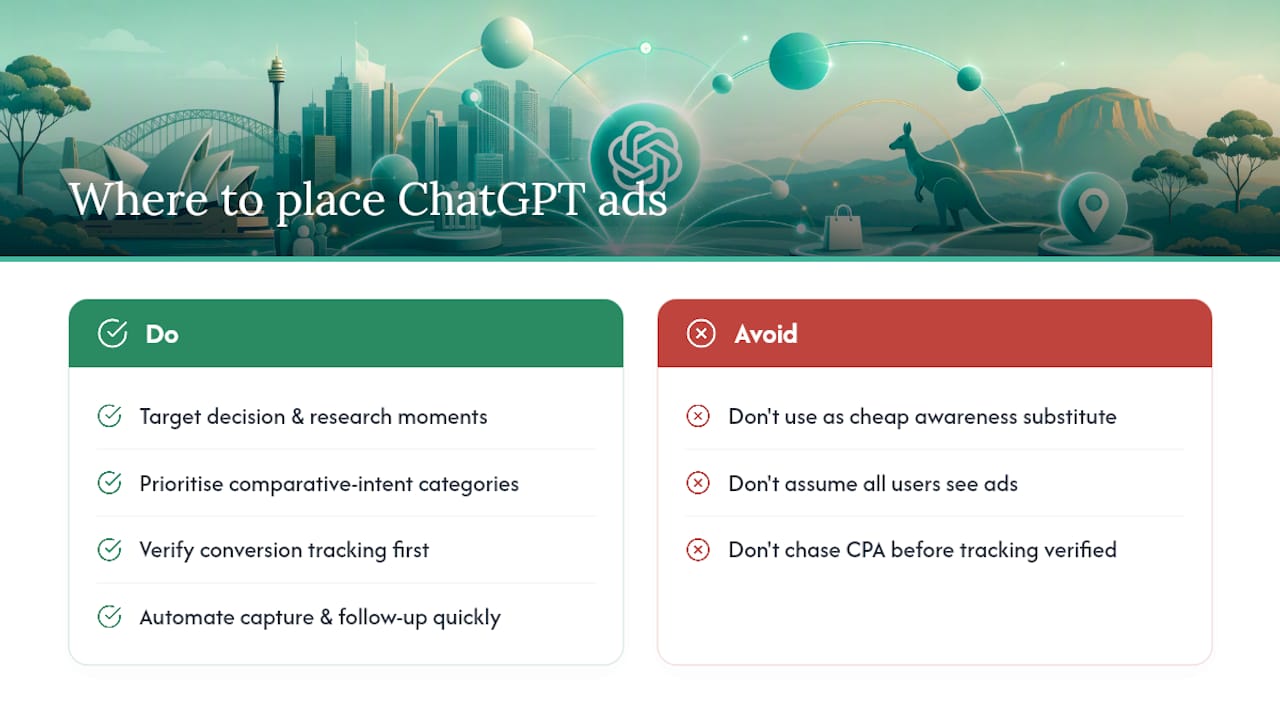
ChatGPT earns its place in decision-oriented, research-heavy moments, not as a cheap awareness substitute for display. If you’re weighing where to allocate your next test budget, prioritise categories where buyers ask comparative questions before converting.
Get conversion tracking verified before you chase CPA bidding, and be realistic about audience skew. Paid subscribers on ad-free tiers won’t see your placement, which matters more in premium categories. Automation that captures and follows up on ChatGPT-driven leads fast is what actually converts the traffic once it lands.
— Billy
How BeAutomated sets up and manages your ChatGPT ad pilot
Getting CPA bidding working properly means your pixel, your landing page, and your follow-up all have to function as one system, not three separate projects. A trusted specialist can build that system for established Australian businesses that want to test ChatGPT ads management without hiring an in-house media team or guessing at technical setup.
A typical pilot engagement covers the audit of your current tracking, Conversions API or pixel installation and verification, creative and context-hint testing across a defined budget window, and reporting that ties spend directly to leads rather than raw clicks. For mortgage brokers, solar and battery installers, and other high-intent local categories, that means the Lead Recovery Pilot approach extends naturally into paid ChatGPT placements, because the same speed-to-lead automation that recovers missed enquiries is what makes CPA bidding pay off in the first place. If you’re ready to test the channel properly, get in touch through Beautomated’s ChatGPT ads management page to scope a pilot.
Sources
- New ways to buy ChatGPT ads | OpenAI
- ‘Everything is coming down’: ChatGPT ads are getting cheaper
- FAQ on ChatGPT Advertising: Formats, costs, and early strategies to win
- OpenAI Ads Manager
- ChatGPT ads, what they cost, how they work, and setup guide
FAQ
Does ChatGPT have paid ads?
Yes. OpenAI runs a self-serve Ads Manager supporting CPM, CPC, and, for accounts with verified conversion tracking, CPA bidding.
Is $20 a day a reasonable ChatGPT ads budget?
It’s workable for early testing but tight for reliable data. Most guidance recommends $100–$300 a day over two to four weeks to get a statistically useful read on CTR and CPC.
How much does a ChatGPT ad placement cost per click?
Typical starting CPCs sit at $3 to $5, with more competitive categories like finance or legal often clearing toward the top of that range or above it.
How are ChatGPT ads performing compared to other channels?
Early results skew strongest for decision-oriented, research-heavy queries, with CTR and conversion quality varying widely by vertical. A 90-day blended CPA comparison against your Google or Meta benchmarks is the most reliable way to judge fit.
Should I use OpenAI’s Ads Manager or a partner like Criteo?
Use direct Ads Manager if you already have first-party tracking and want granular bid control. Use a partner such as Criteo, StackAdapt or Skai if you need existing feed integrations or unified cross-channel reporting.