The BeAutomated journal
ChatGPT Ad Targeting That Converts for Paid Media Teams
Practical playbook for paid media teams: craft context hints, handle the 25,000 matched user minimum, set tracking, and run a four week pilot to test fit.
ChatGPT Ad Targeting That Converts for Paid Media Teams
ChatGPT matches ads to conversation context, not keyword bids or demographic profiles. You control delivery with context hints, campaign-level geography and landing-page relevance, while OpenAI’s ad system decides expected relevance using conversation context and ad metadata alone. There’s no audience-list targeting in the traditional sense, no keyword auction, and ads never touch model responses. First-party audiences exist, but the minimum-match rules keep them out of reach for most small advertisers.
TL;DR:
- ChatGPT ads target users based on conversation context and geography, not traditional keywords or audience profiles, limiting small advertisers’ first-party audience access.
- Ads appear only on free or logged-out sessions for users over 18, with placements varying by device, and are clearly labeled to distinguish them from AI responses.
- Campaigns require well-crafted context hints and relevant landing pages, as performance heavily depends on matching language and intent, with a minimum of 25,000 matched users needed for audience uploads.
- Early data shows these ads perform best for research-stage, comparison, or high-intent purchases, behaving more like search traffic than social engagement.
- Running a managed pilot helps optimize targeting, creative, and tracking, while avoiding common issues like broad hints or lack of attribution, making it easier to assess suitability.
BeautomatedMake Every Enquiry CountBeAutomated helps established Australian businesses improve follow-up, communication, and visibility with AI-driven automation.Explore BeAutomated
Table of Contents
- What are ChatGPT ads and where do they appear?
- How does ChatGPT ad targeting actually work?
- Setting up campaigns in ChatGPT Ads Manager
- What do ChatGPT ad formats look like?
- Measuring ChatGPT ad performance: what to track
- Creative and landing-page checklist for ChatGPT ads
- What are the limits, risks and privacy rules for ChatGPT ads?
- How a managed ChatGPT ads pilot can be run
- What goes wrong when you target ChatGPT ads (and how to fix it)
- How does ChatGPT ad targeting compare to Google and Meta?
- Author view: when to test ChatGPT ads
- Start a managed ChatGPT ads pilot with a specialist provider
- Sources
- FAQ
What are ChatGPT ads and where do they appear?
ChatGPT ads show up only to specific account types. Paid subscribers on Plus, Pro, Business or Edu plans never see them; the ads run on Free and Go plans plus logged-out sessions, and OpenAI restricts eligibility to users 18 and over.
Every ad carries clear labelling that separates it from the model’s actual answer, so there’s no confusion about what’s sponsored and what’s ChatGPT’s own response. Placement and format vary slightly by surface:
- Web: ads typically render as a distinct card beneath or alongside a relevant answer.
- iOS: placement follows native app conventions, usually inline within the conversation thread.
- Android: similar inline treatment, though load times and creative sizing can differ from iOS.
That labelling matters for trust. It also means your creative has to work harder to earn a click, because it’s competing with an answer the user actually asked for.
How does ChatGPT ad targeting actually work?
There’s no keyword bidding here, and no demographic dropdown to tick “women 25 to 34” or “interested in home renovation.” The two real levers are context hints and geography, and understanding how each one behaves is the difference between a campaign that gets traction and one that burns budget guessing.
Context hints are short, topical prompts you write at the ad-group level to tell the matching engine what kind of conversation your ad suits. They work like a briefing note for the algorithm, not a list of keywords to stuff in the same way you’d approach a search campaign.
- Write hints as a specific intent, not a broad category: “comparing solar battery brands for a home installation” beats “solar.”
- Avoid vague single words. “Insurance” tells the system nothing; “getting a quote for landlord insurance in a rental property” gives it a real signal to match against.
- Keep hints short. They’re prompts, not paragraphs, and OpenAI’s own guidance treats them as brief descriptions of user intent rather than keyword inventories.
Geography works at the campaign level through country targeting, and some markets support finer granularity such as regions, DMAs or postal codes. That’s closer to search-engine geo-targeting than to social platform audience building.
The absence of demographic selectors and keyword auctions isn’t a gap in the product. It’s a deliberate design choice that pushes advertisers to think in terms of intent and context rather than audience profiles.
Pro Tip: Early tests reported by Search Engine Land found that keyword-style context hints sometimes beat conversational ones on click-through rate and cost-per-click. Write two versions of every hint, one plain and topical, one more conversational, and let the data settle it.
Setting up campaigns in ChatGPT Ads Manager
Campaign structure follows a familiar hierarchy: campaign, ad group, ad. The fields you configure at each level are what actually shapes delivery.
At campaign level you set:
- Objective (awareness, traffic or conversion focused)
- Budget and schedule (start and end dates)
- Country targeting
- Platform targeting (web, iOS, Android, or a mix)
At ad-group level, the context hint box is where the real targeting craft happens, alongside creative sets and exclusion settings for contexts you don’t want your ad appearing near.
First-party audience uploads are supported too, but there’s a catch worth knowing before you plan around them: OpenAI requires a minimum of 25,000 matched users for a custom audience to activate. That threshold rules out the feature for most small and mid-sized advertisers with modest customer lists, which means your targeting strategy has to lean on context hints and geography rather than uploaded audiences.
Platform targeting also affects which creative formats are eligible, so decide your platform mix before you finalise ad sizes and copy length.
What do ChatGPT ad formats look like?
Ad creative on ChatGPT is deliberately compact. You’re not designing a display banner or a carousel; you’re writing something that reads naturally inside a conversation.
- Formats are typically short headline plus brief description, sometimes with a single clear call to action.
- Copy needs a conversational tone that doesn’t feel like it was lifted from a search ad. It sits next to an AI-generated answer, so an obvious sales pitch stands out for the wrong reasons.
- CTAs should be direct and low-friction. “Get a quote” or “Compare options” fit the format better than anything demanding multiple steps.
- Landing-page relevance matters more here than in most channels, because the whole system is built around matching intent, not clicking through to browse.
If your landing page doesn’t mirror the context hint’s language, you lose the coherence that made the match work in the first place.
Measuring ChatGPT ad performance: what to track
The primary metrics are the ones you’d expect from any paid channel: impressions, click-through rate, average cost-per-click and downstream conversion events. What’s different is how to interpret them.
ChatGPT clicks tend to behave like search-intent traffic rather than social-scroll traffic, because the user was already mid-conversation about a specific need when the ad appeared. That means your funnel expectations should lean closer to search campaigns: fewer, higher-intent clicks rather than high volume, low-intent impressions.
Early benchmark signal: initial campaign tests found that keyword-style context hints sometimes produced higher CTR and lower CPC than fully conversational prompts, an early indication that ChatGPT’s matching behaves closer to search intent than to broad audience targeting.
Because OpenAI doesn’t share conversation-level triggers with advertisers, you need your own tracking to close the loop. Set up UTM parameters on every landing-page link, install conversion pixels, and where possible run server-side event tracking to catch conversions that browser-based pixels miss. Without that instrumentation, you’re flying blind on what actually happened after the click.
Creative and landing-page checklist for ChatGPT ads
Getting the creative and the destination page to agree with each other is what makes context-hint targeting pay off. Run through this before you launch:
- Write a headline that sounds like something a person would say mid-conversation, not a banner tagline.
- Open the landing page with language that mirrors your context hint almost word for word, so the transition from ad to page feels seamless.
- Make the page load fast and design it mobile-first. Most ChatGPT sessions happen on a phone.
- Give the visitor one clear next step. A single form, one phone number, one booking link. Not three competing CTAs.
- Test variations of your context-hint phrasing alongside short-form creative changes, and compare CTR and CPC across each pairing rather than assuming one version will win outright.
Pro Tip: Treat context-hint testing the way you’d treat search query testing. Run at least two phrasing variants for two weeks before you draw conclusions, because the ChatGPT ad system is still early in its optimisation cycle and single-week data can mislead you.
What are the limits, risks and privacy rules for ChatGPT ads?
OpenAI enforces policy restrictions that shape what you can advertise and where. Political advertising faces tight restrictions, and sensitive categories carry their own rules worth checking before you build a campaign around them.
- Advertisers never receive conversation text, and ads cannot influence or alter a ChatGPT response, which protects users but also limits how granular your targeting insight can get.
- OpenAI is testing exclusion targeting so advertisers can flag contexts they don’t want their ad appearing next to, useful for brand-safety-sensitive categories like finance or health.
- Because the exclusion tools are still rolling out, review your creative for anything that could land awkwardly next to an unrelated or sensitive conversation, and build in generic fallback creative where the risk feels real.
How a managed ChatGPT ads pilot can be run
A three-tier system can combine AI-driven follow-up automation, organic visibility in AI search tools, and managed sponsored placements including ChatGPT ads. That combination can help a pilot not just chase clicks, but also close the loop on what happens after someone clicks.
A typical pilot involves drafting and testing context hints against real search-intent behaviour, optimising the landing page so its language mirrors the ad, and setting up UTM and conversion tracking before the first dollar spends. This measurement discipline can help turn an experimental ad channel into a repeatable one. Direct involvement in delivery ensures continuity between context hint creation and campaign analysis.
What goes wrong when you target ChatGPT ads (and how to fix it)
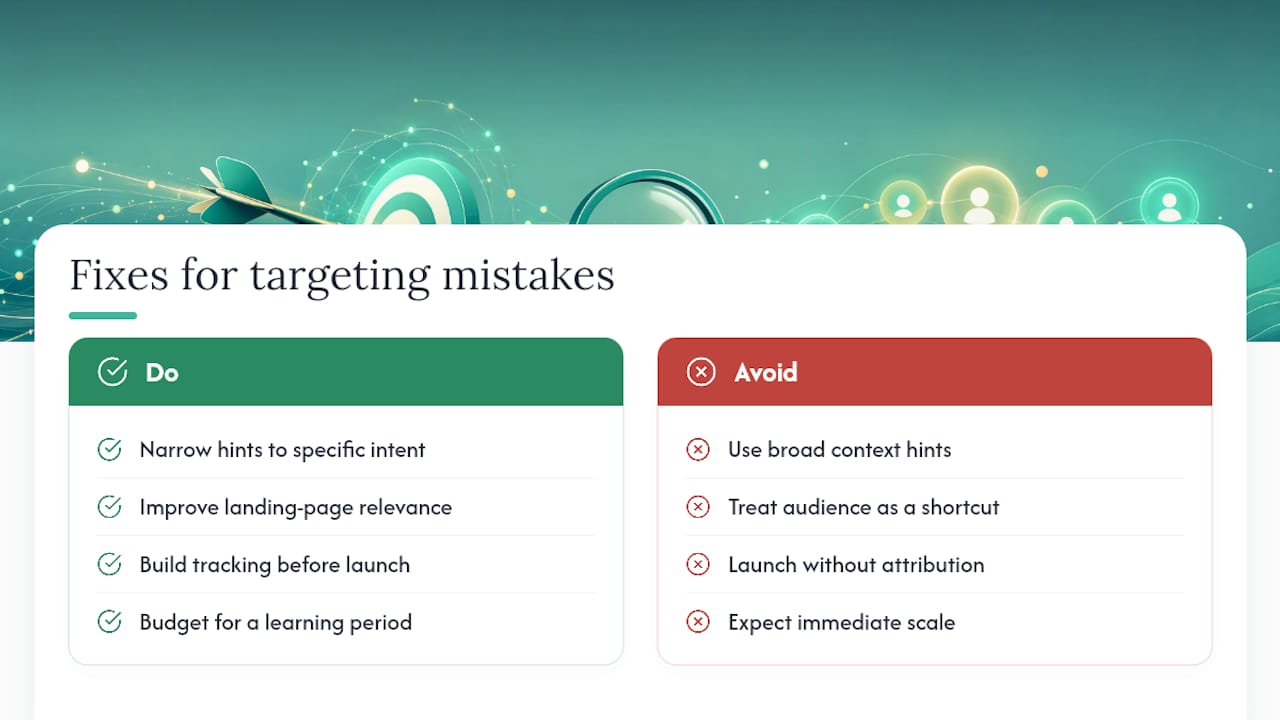
Most early campaign problems trace back to one of three mistakes, and they’re all fixable once you know what to look for.
Context hints that are too broad. A hint like “home services” or “finance” gives the matching engine almost nothing to work with, and you’ll see impressions without relevance. Narrow the hint to a specific intent: not “insurance” but “comparing landlord insurance quotes before a lease renewal.” The more precisely the hint describes a real conversation, the better the match.
Treating the audience feature as a targeting shortcut. The 25,000 matched-user minimum for custom audiences means most SMB advertisers can’t use first-party uploads at all. Rather than waiting to hit that threshold, focus effort on landing-page relevance and use tools like a database reactivation approach to work your existing leads through other channels, saving ChatGPT ads for fresh intent capture instead.
No attribution setup before launch. Because OpenAI doesn’t share conversation-level data, advertisers who skip UTM tagging or conversion pixels end up with impressions and clicks but no idea which ones converted. Build tracking first, launch second.
Assuming performance will mirror search or social. ChatGPT click behaviour sits closer to search intent, but the volume and audience size are still smaller than an established search campaign. Budget for a learning period rather than expecting immediate scale, and treat the first few weeks as calibration, not a verdict on the channel.
How does ChatGPT ad targeting compare to Google and Meta?
ChatGPT ads sit in a different category to both search and social platforms, and comparing them on the same axis misses the point. Google Ads runs on keyword auctions and explicit intent signals typed by the user. Meta runs on demographic and behavioural audience data built from years of platform activity. ChatGPT runs on conversational context inferred in real time, with no keyword bidding and no demographic targeting at all.
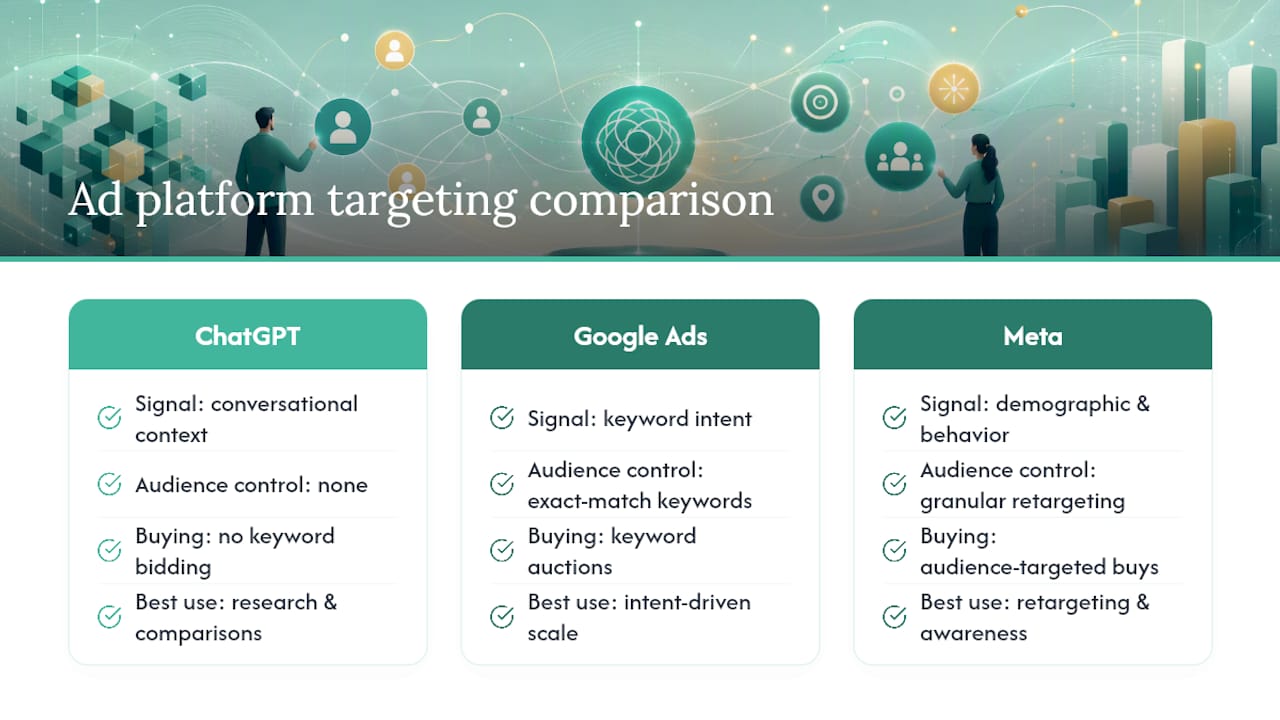
That difference cuts both ways. You lose the granular audience controls that make Meta so precise for retargeting, and you lose the exact-match keyword control that makes Google predictable at scale. What you gain is placement inside a genuinely high-intent moment, a user actively working through a decision in real time, which is a different kind of signal to a search query typed into a box.
For research-stage and comparison-heavy purchases, mortgage products, solar installations, professional services, that conversational context can outperform a cold display impression even without the same targeting precision. For high-volume retargeting or broad brand awareness plays, established platforms with mature audience infrastructure still have the edge, at least until OpenAI’s ad controls mature further.
Author view: when to test ChatGPT ads
ChatGPT ads suit research-stage buyers, comparison queries and qualified lead-gen where intent runs high but volume doesn’t need to be huge. Skip it if your buyers are mostly on ad-free paid plans or your addressable list is tiny. A sensible pilot: four weeks, a modest budget, two context-hint variants, and a clear conversion target before you scale.
— Billy
Start a managed ChatGPT ads pilot with a specialist provider
A managed pilot provides an alternative to running this experiment blind: instead of guessing at context hints and hoping your landing page happens to match, you get a pilot built around measurement from day one.
The pilot covers context-hint drafting and testing, ad creative written for the conversational format, landing-page optimisation so the page mirrors the hint’s language, and full tracking setup with reporting on CTR, CPC and conversion events. It suits established Australian businesses where a qualified enquiry has real value, mortgage brokers, solar and battery installers, and local professional services chasing research-stage buyers rather than cold traffic. If you’re weighing up whether ChatGPT ads fit your funnel, start with a look at Beautomated’s ChatGPT ads management page and get a straight answer on whether a pilot makes sense for your business.
Sources
- Ads in ChatGPT | OpenAI Help Center
- How to run ChatGPT ads: A step-by-step guide from early campaigns
- EXCLUSIVE: OpenAI Is Testing Exclusion Targeting for ChatGPT Ads
FAQ
Are ChatGPT ads targeted?
Yes, but through context hints and geography rather than keyword bids or demographic data. The ad system matches based on conversation context and ad metadata, not a user profile.
Why is ChatGPT giving me ads?
You’re likely on a Free or Go plan, or using ChatGPT logged out. Paid subscription tiers don’t see ads, so their appearance usually signals your account type rather than anything about your conversation topic being sold to advertisers.
Is ChatGPT going to start advertising?
ChatGPT ads are already live for Free, Go and logged-out users, and OpenAI continues to expand targeting controls, including tests of exclusion targeting for brand safety.
Is ChatGPT good for ads?
It works well for research-stage and comparison-heavy purchases where intent is high, and early data suggests clicks behave like search traffic. It’s less suited to broad awareness campaigns or advertisers needing large-scale demographic targeting. A managed pilot through a provider like Beautomated is a practical way to test fit before committing a bigger budget.